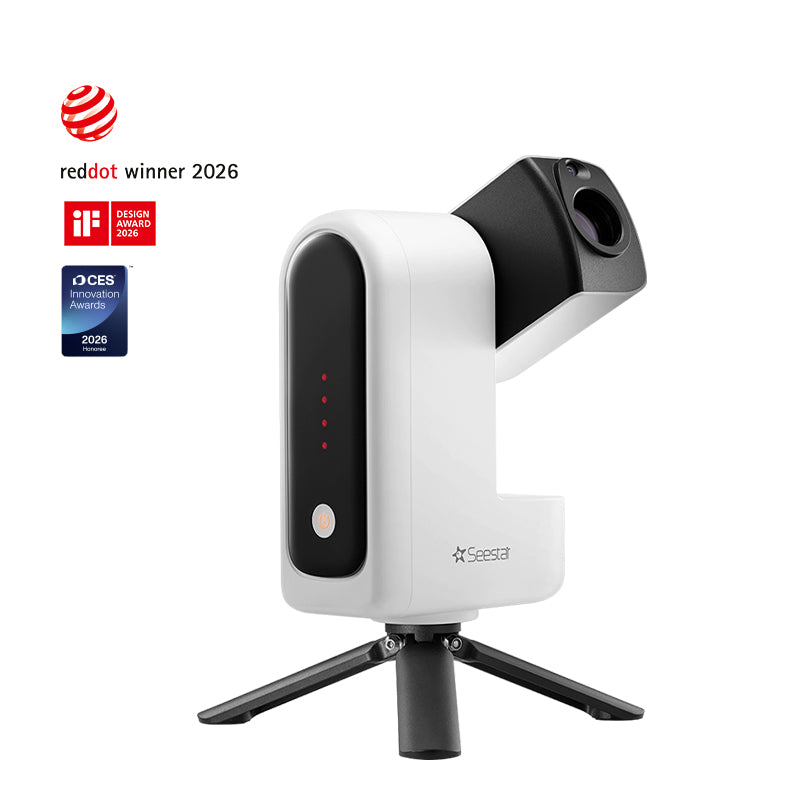
The Smart Sky Survey links several compact smart telescopes into one array that tiles a region of sky all night long — rebuilding the same mosaic every hour so that anything that moves, brightens, or appears can be caught in the act.
Photos courtesy of ZWO / seestar.com, DWARFLAB / dwarflab.com, and Vaonis / vaonis.com — smart telescope platforms this project can support.
Small telescopes, used together, can do something a single big telescope can't do easily: watch a wide area repeatedly, all night, without moving between completely different targets.
Several Seestar smart telescopes point at neighboring, slightly overlapping patches of sky at the same time — together they cover one large contiguous field, like tiles in a mosaic.
Each patch is exposed and stacked for 5–10 minutes. Then the whole array slews together to the next patch — tiling across the target region roughly once per hour.
Because every patch gets revisited about once an hour, all night, asteroids, comets, satellites and transients reveal themselves by shifting or appearing between passes.
There are two levels of tiling at play: the fixed arrangement of telescopes within the array, and the sequence of sky positions the whole array steps through over the night.
Every telescope is leveled, polar-aligned for EQ tracking, and connected over ASCOM/Alpaca to the control host.
A precomputed list of sky tiles — generated from the target region, array arrangement, and field of view — is loaded and filtered for the night's twilight window and altitude limits.
The control host sends each telescope its own goto coordinate — offset from the array's shared center — so all scopes point at their tile of the current mosaic simultaneously.
Each scope exposes and stacks for 5–10 minutes, then the stacked frame is saved with a name that records the scope, tile, and cycle it belongs to.
The array advances to the next tile in the plan. After the last tile, it loops back to the first, so the whole region gets revisited roughly once per hour until dawn.
Every part of the array is controlled and coordinated in software, so the system scales from a couple of telescopes to a much larger array.
Each Seestar runs in EQ mode rather than its default alt-az mode, eliminating field rotation across multi-minute stacks and keeping frame orientation consistent from tile to tile and night to night.
Telescopes are driven through ASCOM Alpaca — an IP-based, scriptable standard — rather than the stock mobile app, so goto, exposure, and status can be orchestrated across the whole array from one place. Best for locally-owned, locally-networked units.
ZWO's own app supports remote control and time-limited device sharing between accounts — so a telescope owner anywhere can lend the project their Seestar for a night. This lowers the barrier to a bigger array: no hardware to buy, no local network to join, just a shared session for the night.
A coordinate-math tool computes per-telescope and per-tile RA/Dec targets from field of view, overlap percentage, and array arrangement (2×2, 3×2, and beyond), and builds the full night's tile plan in advance.
Every stacked frame is named and indexed by telescope, sky tile, and hourly cycle — so images can be automatically grouped into time series for detection, or mosaicked into a full picture of the surveyed region.
The hourly revisit cadence is what makes the survey scientifically interesting — the same processing pipeline that builds a mosaic can also spot what changed between visits.
| Stage | What happens | Why it matters |
|---|---|---|
| Per-tile stacking | Sub-exposures for each 5–10 minute block are combined into one clean frame. | Removes noise, boosts faint signal for each patch. |
| Time-series alignment | All hourly visits of the same tile are astrometrically registered to a common frame. | Makes frames directly comparable, cycle to cycle. |
| Blink / difference detection | Sequential frames are compared to flag anything that shifted or appeared. | Surfaces asteroid, comet, and transient candidates automatically. |
| Candidate vetting | Detections are cross-matched against known object catalogs. | Separates already-known objects from genuinely new finds. |
| Mosaic assembly | All tiles from one pass are combined into a single wide-field image. | Gives a full-region view of the sky and validates the tiling itself. |
The array design scales — more Seestars mean more sky covered per hour, or a tighter revisit cadence on the same region. There's room for collaborators at every level.
Contribute observing time, help refine the tiling and control software, or "rent" your own Seestar to the project for a night via remote device sharing — no local setup required.
Use the survey's data streams for teaching, citizen-science programs, or minor-planet and transient research.
Support hardware expansion, hosting, or processing infrastructure — and help scale a growing, open sky-survey network.
Whether you'd like to follow along, contribute a telescope, or explore a partnership — we'd like to hear from you.